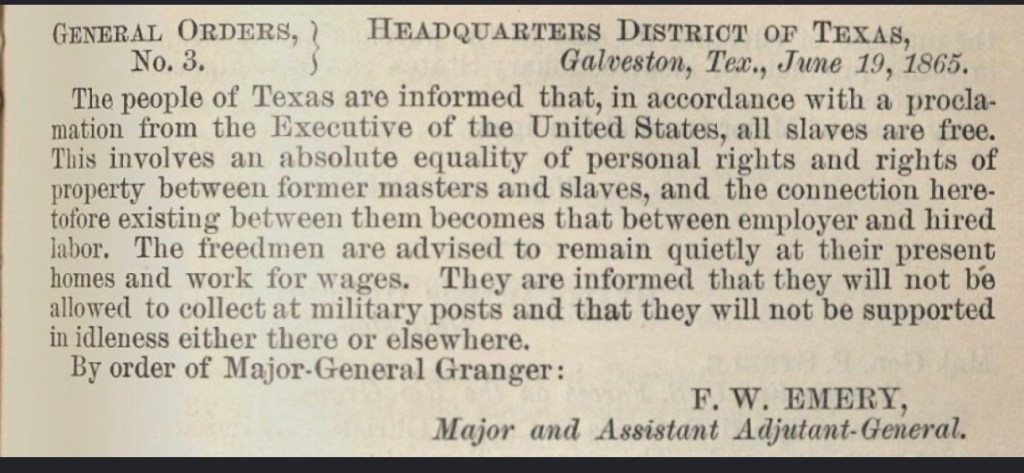
On June 19, 1865, Union General Gordon Granger arrived in Galveston, Texas, and announced that enslaved people in Texas were free.
For many Americans, Juneteenth represents the end of slavery. Yet the story is more complicated.
The Emancipation Proclamation had been issued two a half years earlier. By the time General Order No. 3 was read aloud in Texas, slaveholders throughout the South had spent years resisting, delaying, and evading the inevitable collapse of the system that had made them wealthy.
Some fled westward into Texas with the people they enslaved. Others hid enslaved people from Union troops. Many simply refused to acknowledge a reality they did not want to accept.
For many slaveholders, Texas represented one of the last places where they believed the institution could survive, even as the Confederacy collapsed around them.
Juneteenth reminds us that freedom can be declared in a document long before it is experienced in daily life.
Why Texas Became a Refuge
Quick history lesson about the Battle at the Alamo: Many Anglo-American settlers who migrated to Texas sought economic opportunity, land, and greater local autonomy. For those whose wealth depended on enslaved labor, Mexico’s abolition of slavery created a growing source of tension. They declared allegiance to Mexico and became Mexican citizens. Some, including my distant relative, James “Jim” Bowie, even married Mexican women, to further embed themselves into the fabric of Mexico.
Slavery was one of several major points of conflict between the Mexican government and many Anglo settlers in Texas. When Mexico abolished slavery in 1829, many settlers who had built their wealth around enslaved labor sought ways to preserve the institution despite Mexican law.
Just like all movements, protests, revolts, people with similar grievances come together as a collective force. Texian settlers and their allies revolted against Mexican authority and captured the Alamo in December 1835.
In February 1836, General Lopez de Santa Anna led the Mexican army to the fortified mission to reclaim what was Mexico’s. They whooped up on the Texians. A month later, the Texian army, led by General Sam Houston, battled Santa Anna’s troops at San Jacinto, and captured Santa Anna. This power play gave Texians their independence not just from Mexico but further solidified in their minds an independence from the American government.
These developments helped make Texas an attractive destination for slaveholders who sought to preserve and expand a system built upon the trafficking, enslavement, and exploitation of Black people.
Freedom on Paper
Here’s an image of General Order No. 3 that I found on the Galveston Historical Foundation’s website.
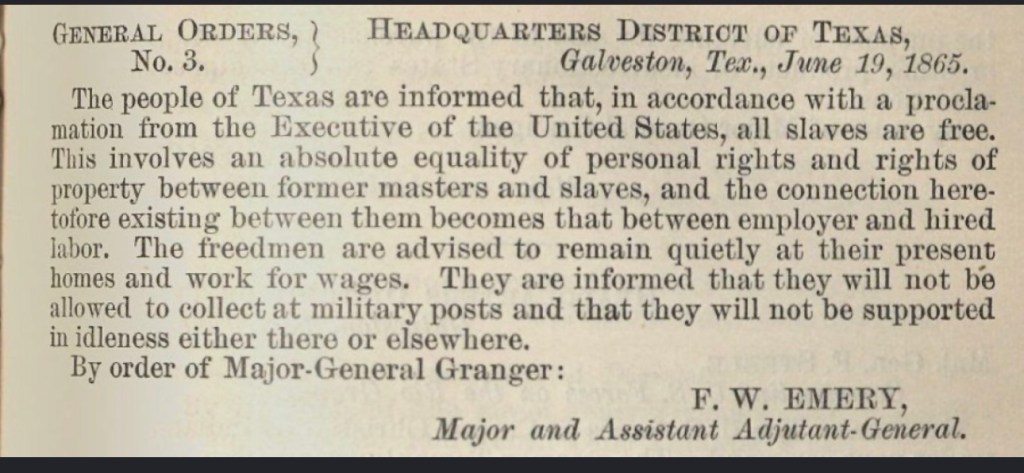
General Order No. 3 said “The freedmen are advised to remain quietly at their present homes and work for wages.”
How meaningful is freedom when every economic incentive and every social pressure pushes you to remain where you already are?
To modern readers, the instruction to “remain quietly” raises uncomfortable questions. Was the order simply intended to prevent violence and chaos during the transition from slavery to freedom? Or did it also reflect a desire to preserve existing power structures by encouraging formerly enslaved people to remain in familiar labor arrangements?
The order continues by stating that freed people: “They are informed that they will not be allowed to collect at military posts; and that they will not be supported in idleness either there or elsewhere.”
Federal authorities were not planning to provide broad economic support to millions of newly freed people. What options actually existed for a person who had been enslaved their entire life?
Many historians have noted that General Order No. 3 was trying to accomplish two goals simultaneously:
- Announce emancipation.
- Preserve social and economic order during a massive transition.
From the Union Army’s perspective, there was concern about:
- disorder,
- violence,
- displacement,
- economic disruption,
- retaliation by former slaveholders.
Let’s also be clear, not all Union soldiers were pro-emancipation; they were soldiers following orders. That’s no different than many of the realities we face today.
The announcement of General Order No. 3 did not only affect formerly enslaved people. It also fundamentally altered the lives of slaveholders and the broader society that had been built around the institution of slavery. For many white Texans, the order represented economic uncertainty, social upheaval, and the collapse of a labor system upon which they had come to depend. Reactions varied, but many were forced to confront a new reality:
- Enslaved people could no longer be legally bought, sold, inherited, or treated as property.
- Plantation owners would need to negotiate labor arrangements rather than rely on forced labor.
- Families that had accumulated wealth through slavery faced the loss of a significant portion of their assets.
- White Texans who did not own slaves still faced changes to the social, political, and economic hierarchy they had always known.
- Communities were forced to adapt to a society in which formerly enslaved people could exercise greater autonomy over their labor, movement, and family relationships.
Shared Fears Across a Divided Nation
The anxieties felt by many Anglo Texans were not unique. Similar fears and debates had existed for generations throughout the United States. Long before General Order No. 3 was issued, Americans in both Northern and Southern states had wrestled with questions surrounding slavery, labor, citizenship, political power, and economic change. While abolitionists demanded an end to slavery, others worried about how emancipation would affect their livelihoods, communities, and social standing. The arrival of freedom in Texas was therefore not simply a regional event. It was part of a national struggle over what kind of country the United States would become.
Freedom Was Only the Beginning
The reality for many formerly enslaved people was that in 1865 and beyond, they faced impossible choices:
- Stay on the plantation and negotiate wages.
- Leave with little or nothing.
- Search for family members sold away months and years earlier.
The Search for Family, Safety, and Opportunity
One thing that often gets overlooked in Juneteenth discussions is that many newly freed people immediately began:
- searching for their spouses,
- searching for their children,
- searching for their parents,
- searching for their siblings.
The first exercise of freedom was often movement. Not wages, voting, or politics. They wanted to be reunited with family, some they hadn’t seen in years or even decades. No different than the dreamers before them, who were snatched away from their families and shipped thousands of miles away.
Juneteenth is not simply a story about freedom arriving in Texas. It is a story about how difficult it can be to transform a legal declaration into lived reality.
Because the delay wasn’t merely from January 1863 to June 1865. The delay continued long after June 19, 1865. I will explore this in future posts.
~Natasha


